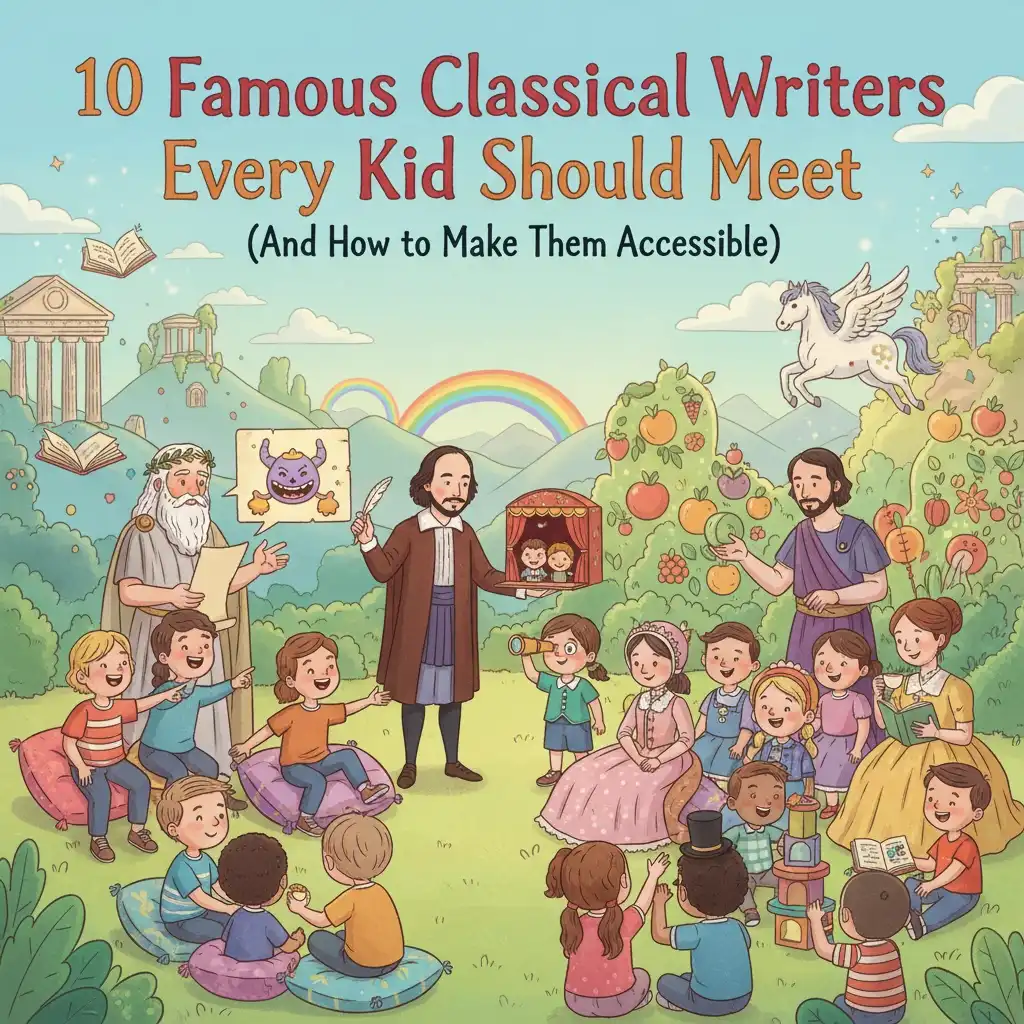
There’s something magical about introducing children to the world of classical literature. These timeless stories have captivated young minds for generations, and with the right approach, they can spark a lifelong love of reading in today’s kids too.
Let’s explore ten remarkable classical writers—some of the most famous classical writers—whose works can open up entire universes of imagination, adventure, and wonder for young readers.
The key to making classical literature accessible isn’t about dumbing down these masterpieces – it’s about finding the right entry points and creating engaging experiences that help children connect with these incredible stories.
Whether you’re a parent, teacher, or just someone who believes in the power of great literature, these writers and their works offer perfect starting points for young literary explorers.
For quick author bios and historical context you can trust, we like Britannica and Biography.com, and for classroom-ready ideas, Scholastic and PBS LearningMedia are go-to resources.
This eye-opening exploration of famous classical writers is all about meeting kids where they are and inviting them to fall in love with reading.
Let’s go on a trip down memory lane and meet them.
1. A.A. Milne: The Master of Childhood Wonder
A.A. Milne’s Winnie-the-Pooh collection remains one of the most beloved introductions to classical literature for children aged 4-8. Milne, one of the famous classical writers, had an extraordinary gift for capturing the essence of childhood imagination, creating stories that feel both timeless and immediately relatable.
Making It Accessible: These stories work beautifully as bedtime read-alouds.
The episodic nature means you can enjoy one short chapter each night, and the gentle humor appeals to both children and adults. Start with “In Which We Are Introduced to Winnie-the-Pooh” and let the magic of the Hundred Acre Wood unfold naturally.

2. Beatrix Potter: Tiny Tales with Big Hearts
Beatrix Potter’s miniature masterpieces, starting with The Tale of Peter Rabbit, combine charming illustrations with perfectly crafted stories. As one of the famous classical writers for young readers, her works are ideal for children aged 3-7, offering just the right balance of adventure and consequence.
Making It Accessible: Potter’s books are naturally accessible due to their size, beautiful illustrations, and manageable length.
Read them in order, starting with Peter Rabbit, and encourage children to examine the detailed watercolor illustrations. These stories work perfectly for developing early reading skills while introducing classic storytelling elements.
3. Lewis Carroll: Adventures in Wonderland
Alice’s Adventures in Wonderland might seem challenging, but Carroll’s playful use of language and absurd situations actually make it perfect for children who enjoy silly, imaginative stories. Best suited for ages 7-11, this classic introduces kids to wordplay and creative thinking.
It’s a delightful bridge into famous classical writers for playful minds.
Making It Accessible: Start by reading aloud together, embracing the nonsensical elements that children naturally love. Don’t worry about explaining everything – let kids enjoy the absurdity.
Consider using an illustrated edition to help visualize the strange and wonderful world Carroll created.
4. E.B. White: Stories That Touch the Heart
E.B. White’s Charlotte’s Web remains one of the most accessible and emotionally resonant classical works for children. White, among famous classical writers, had an extraordinary ability to create characters that feel real and situations that matter, making complex themes like friendship and loss approachable for young readers.
Making It Accessible: Perfect for ages 7 and up, this novel works wonderfully as a read-aloud for families or a first chapter book for independent readers. The straightforward narrative and relatable characters make it an ideal bridge between picture books and more complex literature.
Don’t shy away from the emotional moments – they’re opportunities for meaningful conversations. Teachers can also find simple discussion starters on Scholastic to support gentle, age-appropriate conversations.

5. Rudyard Kipling: Exotic Adventures and Playful Language
Kipling’s Just So Stories and The Jungle Book offer children exciting adventures with unforgettable characters. Among famous classical writers, his “delicious language” and inventive storytelling make these works perfect for children who love animal stories and exotic settings.
Making It Accessible: Just So Stories work excellently as read-alouds for ages 5-8 due to their episodic nature and playful language. For The Jungle Book, target ages 9 and up who can appreciate the adventure and character development.
Kipling’s rhythmic prose makes these stories particularly engaging when read aloud with expression. To set the scene, try a short video or lesson snippet from PBS LearningMedia before you read—the context helps these adventures pop.
6. L.M. Montgomery: Spirited Heroines and Timeless Themes
Anne of Green Gables introduces children to one of literature’s most charming and spirited heroines. Montgomery, one of the famous classical writers, created a character who feels both historical and remarkably modern, making this classic surprisingly accessible for contemporary young readers.
Making It Accessible: Best for ages 9-12, Anne’s adventures work well for children who enjoy character-driven stories. Consider watching the beloved 1985 screen adaptation first to provide visual context, then dive into the book. Anne’s imagination and spirit of adventure resonate strongly with modern children who appreciate independent, creative characters.
7. Mark Twain: American Adventure and Humor
The Adventures of Tom Sawyer has maintained its appeal for over a century, offering timeless themes of friendship, adventure, and growing up. Twain’s humor and understanding of childhood make this classic surprisingly relevant for today’s young readers. Among famous classical writers, Twain shows how humor and heart can live side by side.
Making It Accessible: Recommended for ages 11 and up, this works best as a shared reading experience where parents can help navigate historical context and outdated language. Focus on Tom’s mischievous adventures and universal childhood experiences.
The humor and adventure elements translate beautifully across generations, despite the 19th-century setting.

8. Kenneth Grahame: Friendship and Adventure
The Wind in the Willows offers sophisticated storytelling with beloved characters like Mole, Rat, and the irrepressible Toad—classic hallmarks from one of the famous classical writers. While the language is more complex, the themes of friendship and adventure make it worthwhile for patient young readers.
Making It Accessible: Due to the sophisticated syntax and vocabulary, this works best for ages 10-12 who have already developed strong reading skills. Consider it a “step up” book after children have mastered easier classics.
Reading aloud can help navigate the complex prose while preserving the story’s charm and humor.
9. Robert Louis Stevenson: High-Seas Adventure and Playful Poetry
Robert Louis Stevenson’s Treasure Island sweeps kids into a rip-roaring quest with Jim Hawkins, buried maps, and the unforgettable Long John Silver. For younger readers, A Child’s Garden of Verses offers musical, imaginative poems that celebrate everyday wonder, while Kidnapped delivers another gripping Scottish adventure for tweens.
As one of the famous classical writers, Stevenson pairs page-turning suspense with clear moral choices, making big ideas feel accessible and exciting.
Making It Accessible: For ages 5–8, sample a few poems from A Child’s Garden of Verses and let kids act them out. For ages 9–12, choose an illustrated or abridged Treasure Island; preview nautical terms together, sketch a simple treasure map, and listen to a chapter on audiobook to model fluent reading. Short, focused read-alouds keep the momentum while giving space for quick “what would you do?” conversations.
10. H.G. Wells: Time Travel, Wonder, and What-Ifs
H.G. Wells opens the door to kid-friendly science fiction with The Time Machine, where a curious inventor journeys into the far future and meets the gentle Eloi and shadowy Morlocks. Lightly adapted versions make the big concepts approachable, and curious readers can later explore The War of the Worlds for another pulse-quickening classic.
Among famous classical writers, Wells shows how curiosity and imagination can power stories that feel both thrilling and thoughtful.
Making It Accessible: Start with illustrated or abridged editions for ages 10–12, or read a favorite chapter aloud and pause to predict what happens next. Create a “time traveler’s journal” where kids sketch gadgets, label eras, and jot questions. Compare Wells’s what-ifs with real science videos made for kids, and talk about cause and effect—perfect prompts for short, eye-opening explorations.
Creating a Classical Reading Journey
The beauty of introducing children to these classical writers—and yes, to famous classical writers they’ll meet again later—lies not in checking boxes or meeting educational requirements, but in opening doorways to imagination, empathy, and lifelong learning.
Each of these authors, all famous classical writers in their own right, offers something unique: Milne’s gentle wisdom, Potter’s perfect miniatures, Carroll’s playful absurdity, and White’s emotional depth.
Remember that accessibility doesn’t mean simplification – it means finding the right approach for each child and each story. Some children will dive immediately into independent reading, while others need the shared experience of read-alouds.
Some respond to visual elements, while others connect through discussion and exploration of themes. For help choosing what to read next or which editions to buy, browse the Goodreads list of children’s classics.
The goal isn’t to create little scholars but to nurture young readers who see books as doorways to adventure, understanding, and joy. These famous classical writers have stood the test of time precisely because their stories speak to something universal in the human experience – something that transcends historical periods and speaks directly to young hearts and minds.
At Classic Books for All, we believe that every child deserves access to famous classical writers and their literary treasures. Whether through carefully curated abridged versions for developing readers or beautifully illustrated complete editions, we’re committed to making classical literature accessible and engaging for today’s young readers.
Start your child’s classical literature journey today. Choose one author from this list, find an age-appropriate edition, and begin the adventure together.
You’ll be giving them not just stories, but a foundation for lifelong learning and imagination that will serve them well beyond childhood.
Need ideas? Skim the Goodreads list of children’s classics for inspiration, then you be the judge.
Let’s turn meeting famous classical writers into a shared family adventure.
Introducing Children to the World of Literature with Adapted Classics

Find out how much fun it is to read with your kids by looking through our collection of classic children’s books that have been edited and illustrated just for kids. Our abridged versions of some of the most beloved books of all time are a great way to introduce kids to the world of classic literature authors and will widen your avid reader’s literary horizon. The beautiful illustrations and simple language in these classic books will captivate even the most reluctant readers and will help them develop a love of reading that will last a lifetime. Let’s start building a love of reading!